Wednesday, October 3, 2018

Chemical Peels

Chemical peels are used to improve the appearance of the skin by applying a chemical solution which exfoliates and rejuvenates the skin. They work by dissolving off the top layer of skin.
What are chemical peels used to treat?
Chemical peels are used for the following purposes:
  • Active acne
  • Fine lines and wrinkles
  • Mild scarring from trauma and acne
  • Skin discoloration, sun spots, melasma
  • Skin rejuvenation
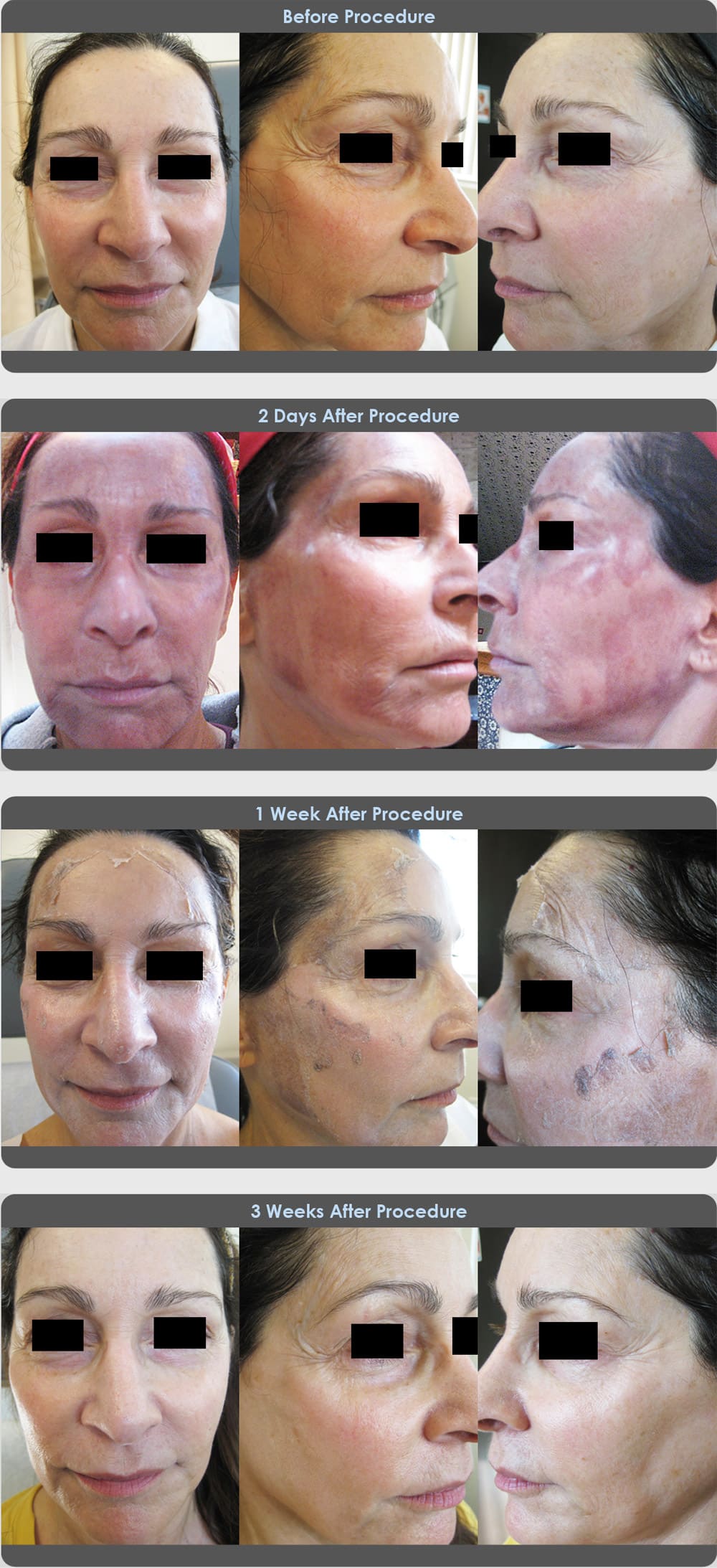
 VISIT OUR CHEMICAL PEEL PHOTO GALLERY
What type of peels are used in your office?
We perform varying strengths of salicylic acid, glycolic acid, or trichloroacetic acid. It is important to use the proper peeling agent based upon your individual skin needs and color.
What should I expect during the treatment?
Most patients experience a warm sensation that lasts about 5-10 minutes, and they may have a stinging sensation after washing the peel off. The more aggressive the peel, the more heat and stinging there is associated with the treatment. The treatment is usually complete within 10 minutes.
What should I expect after the treatment?
There may be a mild to intense sunburn-type sensation after the peel, depending on the type and depth of the chemical used. A superficial peel usually produces redness and a very mild peeling lasting 3-5 days after the treatment. With deeper peels, the redness could last for a couple of weeks, and there will be a more intense peeling reaction. Once the peeling is complete it is safe to wear makeup.
How many sessions will I need?
Depending on the condition being treated, the color of your skin, the strength and type of peel used and your individual response to the peel, you may only need 1 peel, but more often you will require multiple sessions to get the optimal results.
Are there any complications associated with chemical peels?
When done correctly by experienced providers, chemical peels are very safe and there is little risk involved. However, as with any medical procedure, certain complications could occur. These include a temporary or permanent skin discoloration, scarring or redness.

Skin Cancer Treatment

Any new, changing, growing or bleeding mole or lesion should be evaluated by your dermatologist.
Basal Cell Carcinoma:
BCC is the most common form of skin cancer, affecting about 2 million in the US a year. Although it does not have a high metastasis rate, it can be very aggressive and destructive if not treated promptly. It can present in a variety of ways, but often is a pearly colored or pinkish-red shiny bump. It most commonly occurs on the sun exposed areas of the body like the face, scalp, neck, shoulders and back of older patients, although it can occur on any area of the body and in any age group. This is seen more often in those with fair skin, light eyes, freckles and a high incidence of sun exposure. Generally, the treatment is simple and consists of a shave biopsy of the lesion for diagnosis. Further treatment with a deeper shave removal, electrodessication or topical medications may be needed. In some instances surgical excision, Mohs micrographic surgery, or radiation may be required.
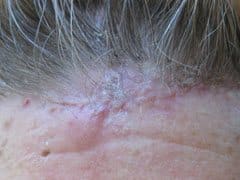
Basal Cell Carcinoma of forehead.
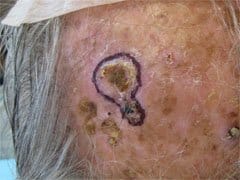
Squamous Cell Carcinoma of forehead.
Squamous Cell Carcinoma:
SCC is the second most common form of skin cancer and does have the ability to metastasize and cause fatalities if left untreated. About 40-60 percent of SCCs arise from an actinic keratosis, also known as precancerous lesions. SCCs often presents as a red scaly patch, an open sore, a wart-like growth, or a raised lesion with a depression in the center. It usually affects individuals in their 50s-70s with light skin, light eyes, a history of high amounts of sun exposure, or on previous or current sites of trauma, burns, scars, and ulcers. SCCs can affect any area on the body, including in the mouth and on the genitalia, but usually occurs on sun exposed areas. Treatment consists of a biopsy of the lesion, and if further treatment if needed consisting of possible topical medications, cryotherapy, electrodessication and curettage, photodynamic therapy, surgical excision, Mohs Micrographic surgery, or radiation therapy.
Melanoma:
Melanoma is the most aggressive form of skin cancer and can affect those in any age group and of any color of skin. If not caught early, it can metastasize quickly and cause death. If treated early it is almost always curable. Those at risk include individuals with one or more of the following: fair skin, light eyes, red or blond hair, freckles, history of blistering sunburns in childhood, anyone with a blood relative who has had melanoma, atypical moles (dysplastic nevi), or a compromised immune system.
Images courtesy of the National Cancer Institute http://www.cancer.gov
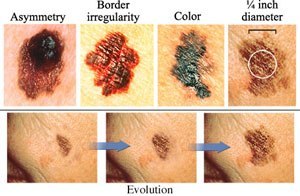
Warning signs of melanoma:
  • The “ugly duckling sign” (any mole or growth that looks different than the rest of the moles and growths on your body).
  • Asymmetry: If you draw a line through the center of the mole, the 2 halves will not match.
  • Border: Uneven borders with notching or scalloped edges.
  • Color: A variety of colors, or change in color.
  • Diameter: Larger than 6mm or ¼ inch (the size of the tip of a pencil eraser).
  • Evolution / Elevation: A mole that is changing or growing, either spreading or becoming raised.
Treatment includes surgical excision, Mohs Micrographic surgery, Chemotherapy and other adjunctive therapies.

SKIN CHECKS & SKIN CANCER


Skin cancer is the most common form of cancer. In the US alone there over 5.4 million cases of non-melanoma skin cancer (basal cell carcinoma and squamous cell carcinoma) treated each year in over 3.3 million people. As Americans are living longer it is now estimated that 1 in 5 of them will be diagnosed with some form of skin cancer in their lifetime. These non-melanoma skin cancers are not usually aggressive and very rarely metastasize. Most patients affected with these types of skin cancer are able to lead normal, healthy lives if diagnosed and treated early. When left unattended, however, these skin cancers can cause significant localized symptoms such as bleeding and pain. Furthermore, they may become locally destructive to underlying and nearby structures causing disfigurement and disruption of function of vital structures such as the eyes, nose and ears.
Most people may not be able to detect non-melanoma skin cancers as they usually do not have the classic worrisome signs of skin cancer. Therefore it is also advisable for everyone to have a full skin exam by a dermatologist on annual basis. This is especially important in those individuals who have risk factors for developing non-melanoma skin cancers. These risk factors include exposure to UV radiation from the sun, fair complexion, artificial tanning, suppressed or weakened immune system, pre-cancerous skin lesions and prior skin cancer history, among others. During a skin cancer screening visit a dermatologist may counsel patients with specific recommendations tailored to their lifestyle and risk factors. Furthermore, it is advisable for everyone to do a full body self skin exam once monthly. Non-melanoma skin cancers come in variety of colors and textures. Lesions that slowly enlarge over time, bleed easily or fail to heal as expected over a few weeks should raise suspicion and thus should be evaluated by a dermatologist as soon as possible.
SCHEDULE A CONSULTATION
The other major category of skin cancer is malignant melanoma which, while only accounting for less than 1% of all skin cancers, accounts for majority of deaths from skin cancer. This is because, unlike basal cell and squamous cell carcinomas, melanomas behave aggressively and can become metastatic (i.e. spread to other distant sites of the body) if left untreated. Therefore, early detection and treatment of melanomas is of utmost importance in determining survival. It is noteworthy that less than half of melanomas arise from pre-existing moles and that majority of melanomas are flat and not raised.

Laser Skin Tightening at LA Laser and Skin Center

What is laser skin tightening?

During laser skin tightening, our specialized laser heats the collagen fibers deep within your skin at specific temperatures. This gentle yet focused heating will slowly rearrange, redistribute, and recreate the collagen structure within your skin. As new collagen forms, your skin will tighten and rejuvenate over time. Once your collagen has been stimulated by laser skin tightening treatments, it will continue to grow for months and even years to come with minimal maintenance required.  
Which parts of the body can laser skin tightening treat? 

Face
Chest
Abdomen
Thighs
Neck
Arms 

Is laser skin tightening treatment right for me?

Laser skin tightening treatment is the perfect treatment for adult men and women.  If you’re committed to proper after care, this procedure is right for you. If you are sensitive to light or have an autoimmune disorder, be sure to speak with your doctor before receiving laser skin tightening treatment.

What can I expect the day I receive laser skin tightening treatment?

Laser skin tightening treatment is a safe, quick, and easy office procedure that takes 30-60 minutes depending on the areas being treated. A skin care specialist will glide the laser applicator over the area to be treated. As the applicator delivers laser energy in tiny bursts, you will feel a heated prickling sensation. Once treatment is complete, a nurse will apply a cool gel to the treated area. Most patients describe the feeling after treatment like a sunburn. This feeling can last anywhere from two hours to two days. 

What will recovery be like after I receive laser skin tightening treatment?

You will be able to go back to work immediately following laser skin tightening treatment. Even though you are able to return to regular activities, it is important to follow the after care instructions given to you by your skin care specialist.  Failure to do so may delay or diminish the results of laser skin tightening.

Do I need to follow a special skin care routine after receiving laser skin tightening treatment?

Your provider will give you detailed instructions about your specific skin care needs. You may receive a prescription for special creams or gels to maximum the results of your laser skin tightening treatment. 
Be sure to use sunscreen daily to protect your skin from sun exposure during both the healing phase and for several months after treatment. Apply a moisturizing sunblock with an SPF of at least 30. For at least six months after treatment, avoid being in the sun as much as possible.

 When will I see results from laser skin tightening treatment and how long does it last?
For most patients, the results are gradual over 2-6 months as new collagen is formed and the skin tightens. Although one treatment will attain significant improvement, it is suggested that three treatments be performed at six week intervals for maximum results. A touch up treatment may be needed once a year for continued results.
 Why choose LA Laser and Skin Center for laser skin tightening treatment?
LA Laser and Skin Center is among the top laser skin tightening providers in the United States, with thousands of procedures performed by our specially trained laser experts. Our luxurious facilities are home to the best cosmetic and medical dermatological care available. Our doors are always open to new patients. If you’re interested in learning more about laser skin tightening and our world class staff of board certified dermatologists, aestheticians, registered nurses, and patient care specialists, call 1-800-501-3376 or request an appointment today.